
Aroids: What They Are and How to Grow Them in Florida
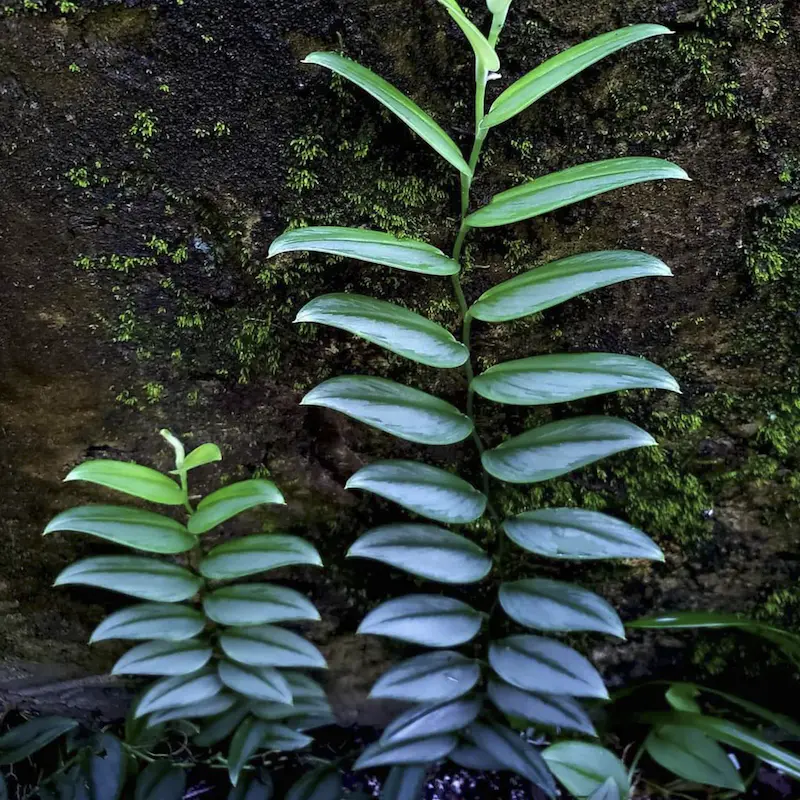
Aroids are one of the most varied plant families in botany, and so familiar that many people have grown one without realizing it.
South Florida is one of the few places in the continental U.S. where many tropical aroids thrive outdoors year round. At Fairchild Tropical Botanic Garden, our horticulturists and volunteers grow the aroids we sell in our Miami nursery, so this guide focuses on plants that adapt well to South Florida yards, screened patios, and living rooms with air conditioning.
In This Article
- What Are Aroids?
- How to Tell If a Plant Is an Aroid
- Types of Aroids by Growth Habit
- Aroids Native to Florida
- 7 Aroids to Grow from Fairchild’s Nursery
- How to Care for Aroids in South Florida
- Keeping Aroids Safe for Pets and Florida’s Natural Areas
- Getting Started with Aroids
- FAQs
What Are Aroids?
An aroid is any plant in the Araceae, also called the arum family. The name comes from Arum, a small genus from Europe and the Mediterranean.
The arum family currently comprises about 140 accepted genera and more than 3,500 recognized species.
Aroids are a diverse group of plants best known for their prominent foliage and distinctive floral structures. Commonly grown as houseplants, they display an extraordinary range of growth habits, from forest-floor plants and tree-climbing vines to rock-adapted species and even aquatic forms.
How to Tell If a Plant Is an Aroid
Aroids are defined by their characteristic inflorescence, a cluster of tiny flowers often mistaken for a single bloom. This structure consists of two parts:
- Spadix: a fleshy spike that bears the flowers.
- Spathe: a modified leaf that surrounds, protects, and highlights the spadix. It is the white “petal” on a peace lily and the glossy red heart on a florist’s anthurium.
When there is no spathe to confirm it, other clues can point to an aroid:
- Leaf stalks with a sheathing base that wraps the stem, with new leaves often unfurling from inside the previous one’s sheath.
- Thick aerial roots at the nodes. Climbing aroids like Philodendron, Epipremnum, and Monstera use them to grip bark (or, left unchecked, your stucco).
- Juvenile leaves that look different from the adult ones. Plenty of climbing aroids start small, then switch to large lobed or split leaves once they find something to climb.
- Sap that can irritate skin.
Types of Aroids by Growth Habit
One of the common ways to differentiate aroid types is by their growth habits. Within the aroid family, some species climb trees, others persist underground during unfavorable seasons, and others flourish while floating on water.
Climbing and Trailing Aroids
Climbing aroids, which include vines and shinglers, ascend toward the light of the forest canopy.
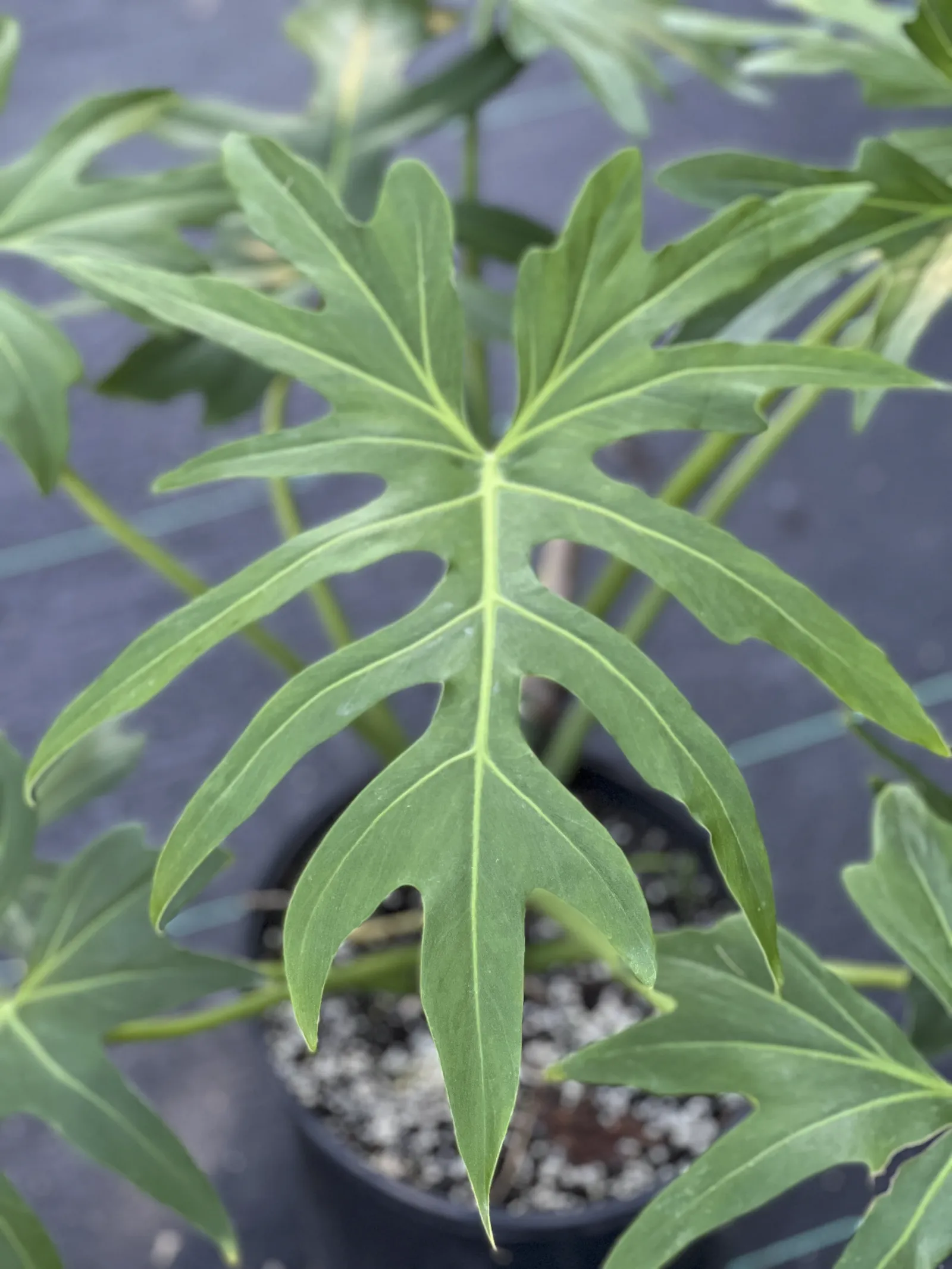
Genera such as Monstera, Philodendron, and Rhaphidophora produce aerial roots at their nodes that anchor the plant to trunks or supports. At Fairchild’s nursery we grow Philodendron radiatum, Philodendron pedatum, Philodendron hederaceum, Epipremnum giganteum, and Epipremnum amplissimum.
Shinglers, such as Monstera dubia, grow flat against tree trunks with juvenile leaves that overlap like roof shingles until mature leaves emerge.
At home, climbing plants can be styled two ways. In hanging planters or on high shelves, the vines cascade over the edge. On a moss pole, trellis, or plank, the aerial roots attach, the leaves often grow larger, and the plant rises into a vertical living wall of layered texture and greenery. Regular pruning keeps either style full, since trimming the tips encourages branching.
Epiphytic Aroids
Species of Anthurium, such as Anthurium gracile and some Philodendron grow upon other plants without harming them.
Epiphytic aroids rely on high humidity, good air circulation, and organic matter that collects around their roots for nutrients. Because they grow without depending on soil, they suit creative displays: mounted on boards or bark, hanging from above, or arranged in vertical gardens.
Upright and Terrestrial Aroids
Terrestrial aroids grow rooted in soil, and many take an upright form, either a clump of stems or a single central stem that stands without support.
Genera such as Alocasia, Spathiphyllum, Aglaonema, Dieffenbachia, and some Philodendron grow this way. Some of the species available at Fairchild’s nursery are Alocasia macrorrhizos var. variegata, Alocasia triangularis, Spathiphyllum phryniifolium, and Aglaonema ‘White Edge’.
Clumps widen as new shoots emerge, so they need a pot with extra room to spread and a spot with space around them. It helps to plan for the width the plant will reach at maturity.
These aroids are valued in home interiors for their visual appeal and their adaptability to indoor conditions. Peace lilies and Chinese evergreens in particular suit rooms with low light conditions.
Geophytic Aroids
Species within genera such as Amorphophallus and Typhonium persist through unfavorable conditions by forming underground corms, tubers, or rhizomes that store energy. These reserves enable the plants to enter seasonal dormancy and resume growth when conditions become more favorable.
A familiar example is the ZZ plant (Zamioculcas zamiifolia), a popular houseplant that tolerates low light and infrequent watering, which makes it a good choice for beginners.
Other examples of geophytic genera are Amorphophallus, Typhonium, Zamioculcas, Colocasia, and Caladium.
Aquatic Aroids
Genera including Cryptocoryne and Lagenandra are adapted to life in or beside water. Some grow fully submerged, and others rise above the surface. They are commonly cultivated in aquariums and paludariums, which are enclosures that combine land and water.
In home water features, they add form, texture, and a sense of connection to the water. As with any aquatic plant in Florida, keep them contained and never release them into local waterways.
Some other examples of aquatic aroids include Cryptocoryne and Lagenandra.
Aroids Native to Florida
Florida has native aroids too, and the three below all grow in wet or moist places.
Green arrow arum (Peltandra virginica) grows along marshes and pond margins, with leaves shaped like arrowheads and a narrow green spathe.
Golden club (Orontium aquaticum) has no showy spathe. A white stalk ends in a bright yellow spadix that rises straight out of shallow water.
Jack-in-the-pulpit (Arisaema triphyllum) prefers moist, shaded woodland, where its hooded spathe, striped in green and purple, hides beneath leaves divided into three leaflets.
7 Aroids to Grow from Fairchild’s Nursery
Every plant below was grown at our nursery in Miami and selected because it handles South Florida conditions. Looking for philodendrons that move between the house and the patio? Our guide to indoor outdoor plants for Florida covers five of them in detail.
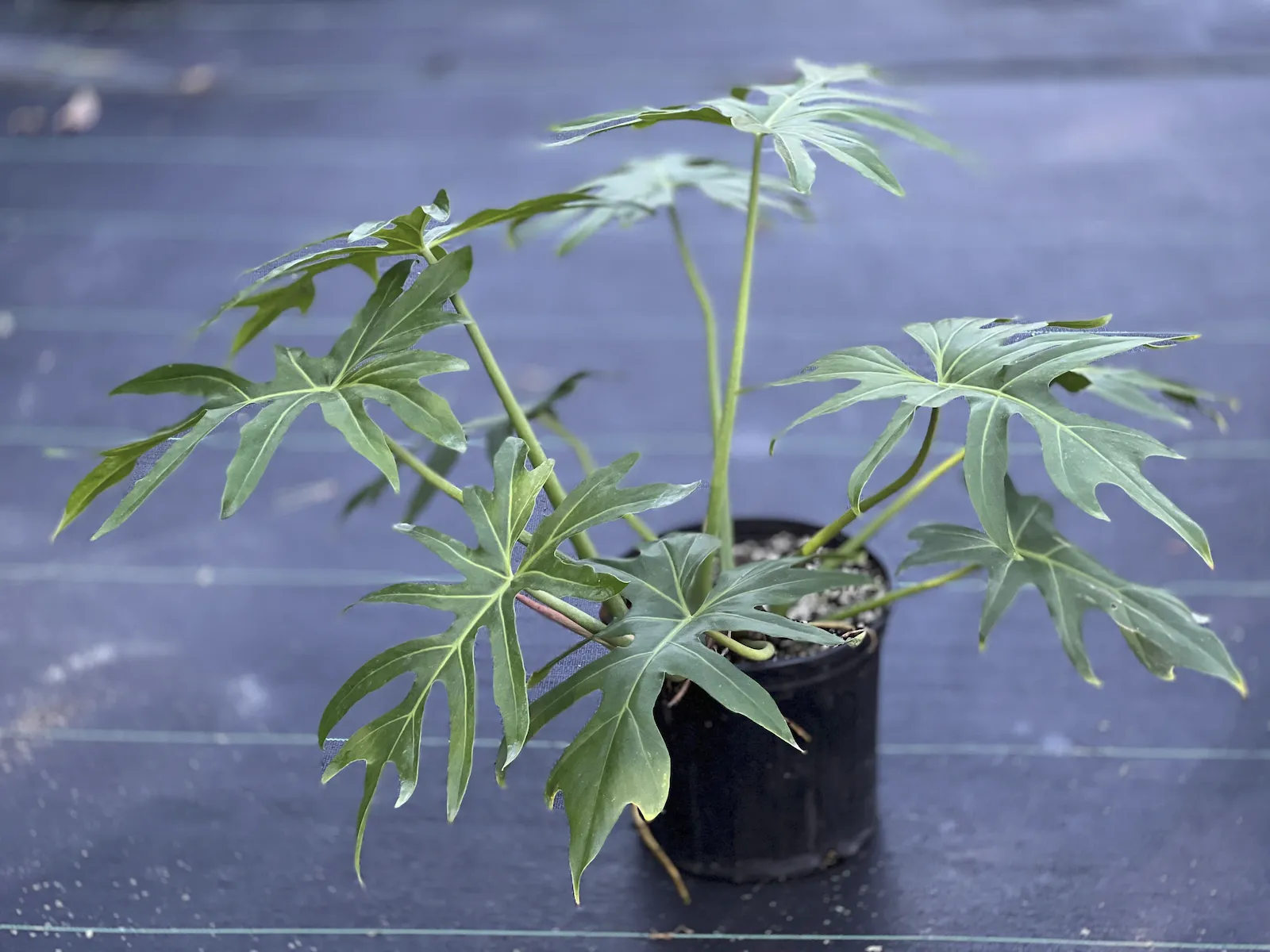
1. Philodendron radiatum (Split Leaf Philodendron): A climbing aroid with large, lobed leaves. Native to the rainforest, it loves humidity, filtered sun, and soil that drains well, and it works as a houseplant, a patio specimen, or a climber in a shaded spot. Pot size: 3 gallons.
2. Philodendron ruthianum: Native to the state of Espírito Santo in southeastern Brazil, this rare climbing aroid showcases irregular shaped leaves that vary from leaf to leaf. It thrives in bright, indirect light, and humidity, and it climbs best with a trellis. We recommend letting the top of the soil dry slightly before watering. Pot size: 3 gallons.
3. Anthurium gracile (Red Pearls Anthurium): Compact in size, this anthurium sends out long flower stalks, which go on to set clusters of red berries. It prefers filtered light without direct sun and a potting mix that drains quickly, and it looks best spilling over the edge of a hanging basket. It is also one of the aroids we ship nationwide. Pot size: 1 gallon.
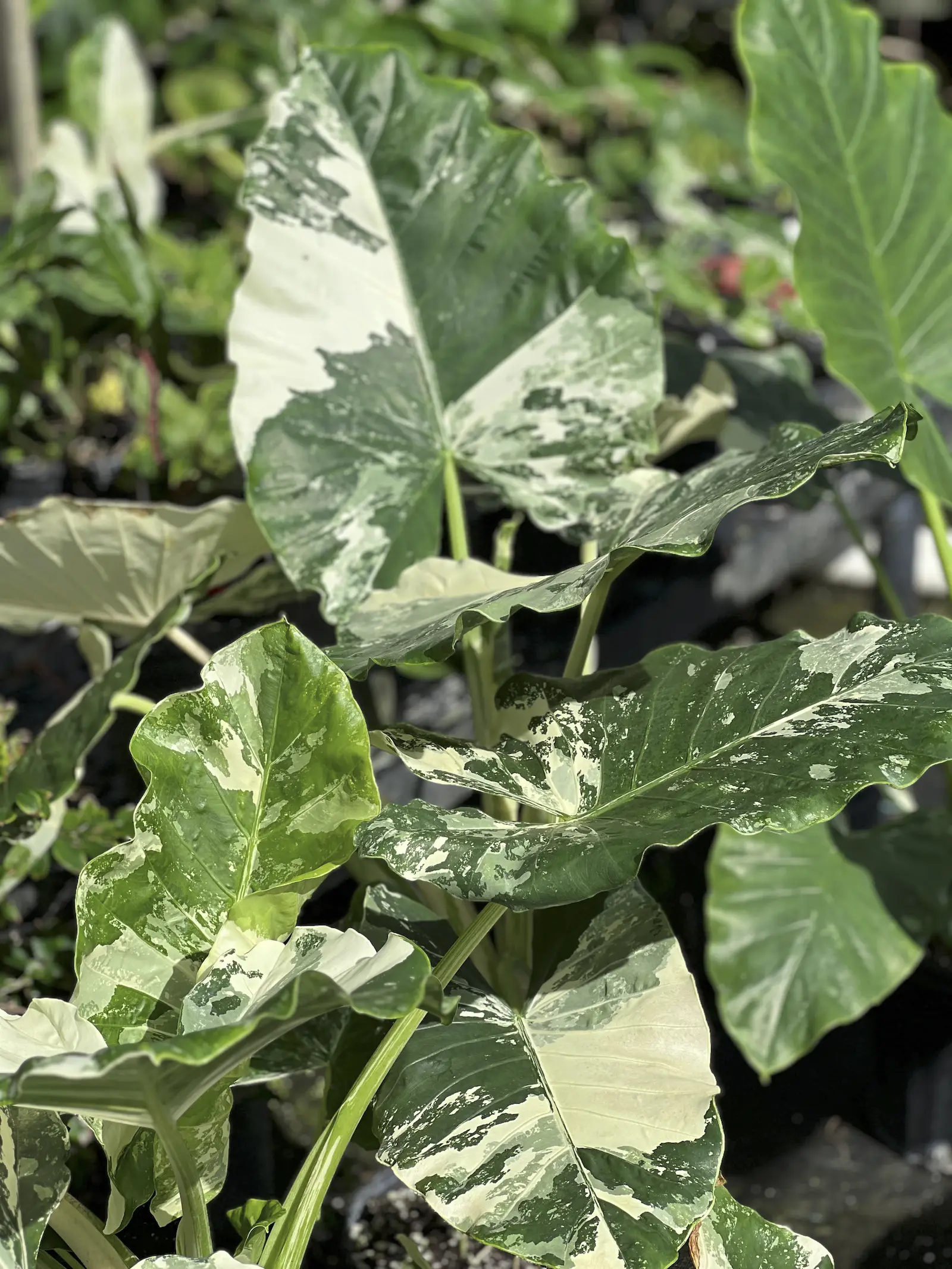
4. Alocasia macrorrhizos var. variegata (Variegated Giant Taro): features oversize leaves shaped like hearts, splashed with cream and pale green. It reaches 5 to 6 feet tall and spreads from tubers, so a few plants can fill a garden bed and act as a living privacy screen. This variety prefers medium to bright filtered light, which keeps its variegation strong. Pot size: 1 gallon.
5. Epipremnum giganteum (Thin Leaf Form): A climber native to the lowland forests of Southeast Asia, with hanging leaves shaped like paddles and edged in faint gold. The higher it climbs, the larger its leaves grow. It thrives in part shade to shade with good drainage and extra water during dry spells. Of the several forms of this species in Fairchild’s collection, this one grows the fastest. Pot size: 3 gallons.
6. Spathiphyllum phryniifolium (Peace Lily): This is a species peace lily, a less common find than the hybrids sold at large retail chains. Like its relatives, it handles shade well and produces white spathes, so it suits a shaded corner indoors or a shaded bed outside. Pot size: 1 gallon.
7. Aglaonema ‘White Edge’ (Chinese Evergreen): Broad green leaves edged in white, on white stems, give this Chinese evergreen a crisp, tidy look. It grows slowly and ranks among the most forgiving aroids for offices and interior rooms, so it makes an easy place to start. Pot size: 3 gallons.
Explore the full aroids collection for climbers, elephant ears, and rare species grown at Fairchild.
How to Care for Aroids in South Florida
Aroid care varies by genus, with most aroids sharing the same starting point: they evolved under a forest canopy. Recreating similar conditions at home is one of the best ways to help them thrive.
Light
Provide bright, indirect light. Most aroids can tolerate lower light levels, but they grow best in filtered sunlight. A window that faces east, or one that faces south or west and is softened by a sheer curtain, offers ideal conditions. Avoid extended exposure to strong midday sun, which can scorch the foliage.
To promote balanced growth, rotate the pot regularly. Like many plants, aroids exhibit phototropism, a natural response that causes stems and leaves to orient toward the light source.
Water, Humidity, and Temperature
Water thoroughly, allow the excess moisture to drain, and let the top 1 to 2 inches of soil dry before watering again. Aroids are sensitive to waterlogged conditions and may develop root rot if the soil stays consistently wet. It is generally safer to underwater slightly than to overwater, and mild leaf drooping can indicate that the plant needs water.
Outdoors, the Miami summer humidity helps recreate their natural environment. From November through April, aroid growth slows and plants need less frequent watering. Indoors, air conditioning can dry out the air and the leaves. Grouping plants together or keeping them away from vents helps.
Aroids prefer warm, stable temperatures between 65°F and 85°F and should be protected from cold drafts and sudden temperature changes.
Like many tropical plants, aroids can suffer chilling injury when temperatures drop below 50°F (10°C), according to UF/IFAS Extension. Move containers under cover or indoors when a cold front is forecast. Tuberous types of aroids, such as alocasias, may lose their leaves in cold weather and push new growth from the base once the temperature warms up, so if your plant does this, give it time to recover.
Potting Mix
When choosing a potting mix for aroids, look for a chunky, airy blend. Climbing and epiphytic aroids grow roots that need plenty of oxygen, and heavy soil can suffocate them. Many growers start with roughly equal parts quality potting mix, orchid bark, and perlite, then adjust as they observe the plant: more bark for anthuriums and a mix that holds slightly more moisture for alocasias. Every pot also needs drainage holes.
Fertilizing, Repotting, and Pest Control
During the active growing season, typically from spring through summer, apply a balanced liquid fertilizer diluted to half strength every four to six weeks. Fertilization may be reduced or paused during the cooler months, when growth naturally slows.
Routine maintenance includes removing yellowing or damaged leaves and repotting every one to two years, or sooner if the roots outgrow the pot. Signs that repotting may be necessary include roots circling the inside of the container, soil drying out unusually quickly, and a noticeable slowdown in growth.
Mealybugs, scale, and spider mites are common pests of aroid plants. Spider mites are especially common in dry indoor air. Check the undersides of leaves and the spots where leaf stalks meet the stem. A strong rinse and insecticidal soap handle most early infestations.
Keeping Aroids Safe for Pets and Florida’s Natural Areas
Plants in the aroid family can be toxic to pets. The calcium oxalate crystals that protect aroids cause mouth pain, drooling, and vomiting in cats and dogs if the leaves are chewed. Keep aroids out of reach of curious animals, and call a veterinarian or the ASPCA Animal Poison Control Center if you suspect a pet ate part of one.
Another consideration is the landscape beyond your yard. A few aroids have escaped cultivation in Florida and now crowd out native plants. The Florida Invasive Species Council lists wild taro (Colocasia esculenta) and arrowhead vine (Syngonium podophyllum) as Category I invasive plants, meaning they are altering native plant communities, and includes golden pothos (Epipremnum pinnatum ‘Aureum’) as Category II. Grow spreading types in containers, and never toss cuttings or tubers into canals, lakes, or woods.
Getting Started with Aroids
Aroids bring texture and bold foliage to a yard, garden, patio, or indoor space. Give them filtered light, an airy mix, something to climb, and protection from the occasional cold front, and most will reward you with bigger leaves every season.
Ready to start or grow your collection? Browse the Aroids collection, grown at the Fairchild nursery in Miami.
FAQs
An aroid is a plant in the Araceae family. Aroids produce a flower structure made of a spadix (a spike of tiny flowers) and a spathe (a modified leaf that surrounds it). The family includes philodendrons, anthuriums, pothos, monsteras, peace lilies, and elephant ears.
Yes. Pothos (Epipremnum) and philodendrons (Philodendron) are both aroids, and they are often confused because their juvenile leaves look similar. So are anthuriums and alocasias.
Yes. Monstera deliciosa belongs to the Araceae family. Its famous split leaves are an adult trait that shows up as the plant matures and climbs.
In the plant trade, “rare” usually describes a plant that is hard to find in cultivation. A species may come from a tiny native range, grow slowly from cuttings, or carry unstable variegation. Philodendron ruthianum, native to the Brazilian state of Espírito Santo, is a good example of an aroid you rarely find at a garden center.
Most are. The calcium oxalate crystals in their leaves and stems irritate the mouth and digestive tract. Keep aroids away from pets that chew plants.
In South Florida, yes. Miami-Dade sits in USDA zones 10b and 11a, and many tropical aroids grow outside year round in shade or filtered light. Farther north, grow them in containers you can move inside during cold weather.